
What Is Food Literacy? The Skills Behind Everyday Eating
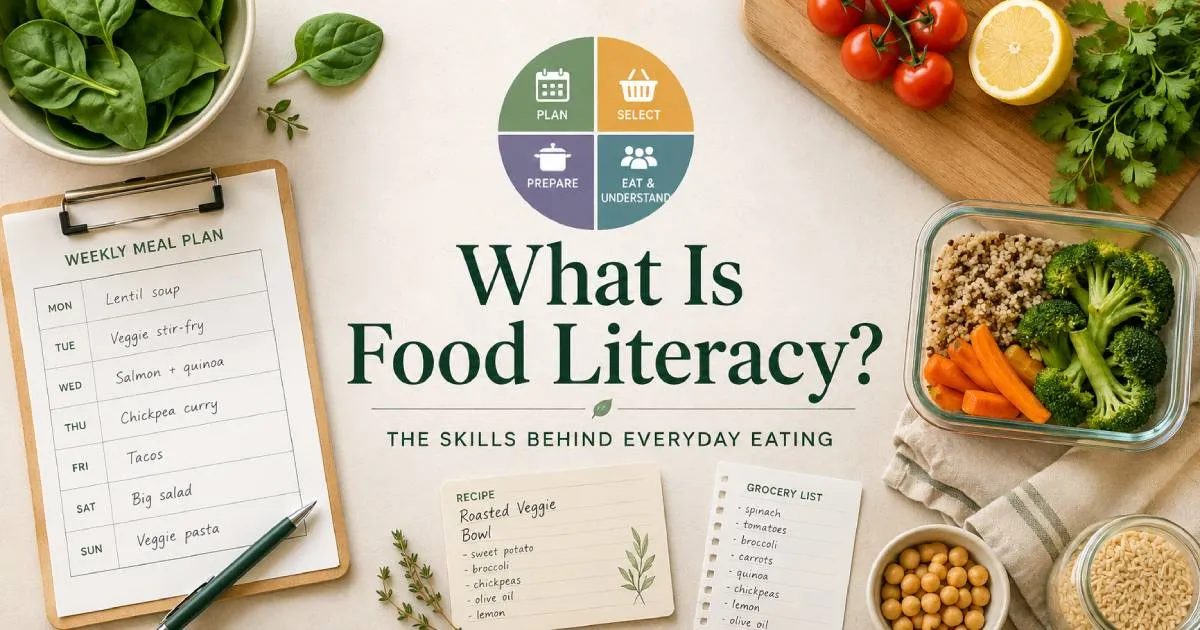
Food literacy is the combination of knowledge, practical skills, confidence and behaviours people use to plan, select, prepare and eat food. It includes reading labels and recipes, choosing ingredients, organising meals, storing food safely, adapting to changing circumstances and understanding how food choices connect with households and food systems.
Key takeaways
- Food literacy combines the knowledge, practical skills, confidence and behaviours used to plan, select, prepare and eat food.
- It is broader than nutrition knowledge or cooking technique because it also involves organisation, judgement, adaptation and critical understanding.
- Planning and managing, selecting, preparing, and eating and understanding are connected parts of the same everyday process.
- Food capability is affected by time, income, access, equipment, culture, physical ability and household responsibilities.
- A food-literacy self-check should help someone choose a useful skill to strengthen, not judge whether they are a good or bad eater.
- Food literacy can help people navigate constraints, but it cannot replace affordable food, adequate time, accessible shops or suitable kitchen facilities.
What Is Food Literacy? The Skills Behind Everyday Eating
Food touches almost every part of an ordinary day. Before anyone chops an onion or follows a recipe, they may need to decide what to cook, check what is already at home, work within a budget, choose between products, judge freshness, fit cooking around work or care responsibilities, and store the result safely.
Food literacy is the broad set of abilities that makes those decisions possible. Researchers commonly describe it as a combination of connected knowledge, skills and behaviours used to plan, manage, select, prepare and eat food.
It is useful to think of food literacy as practical capability rather than a personal grade. People can be highly capable in one area and less confident in another. Someone may cook skilfully but find labels confusing. Another person may understand nutrition well yet struggle to organise meals around an unpredictable week.
These differences do not make either person a “good” or “bad” eater.
Food literacy is more than knowing about nutrition
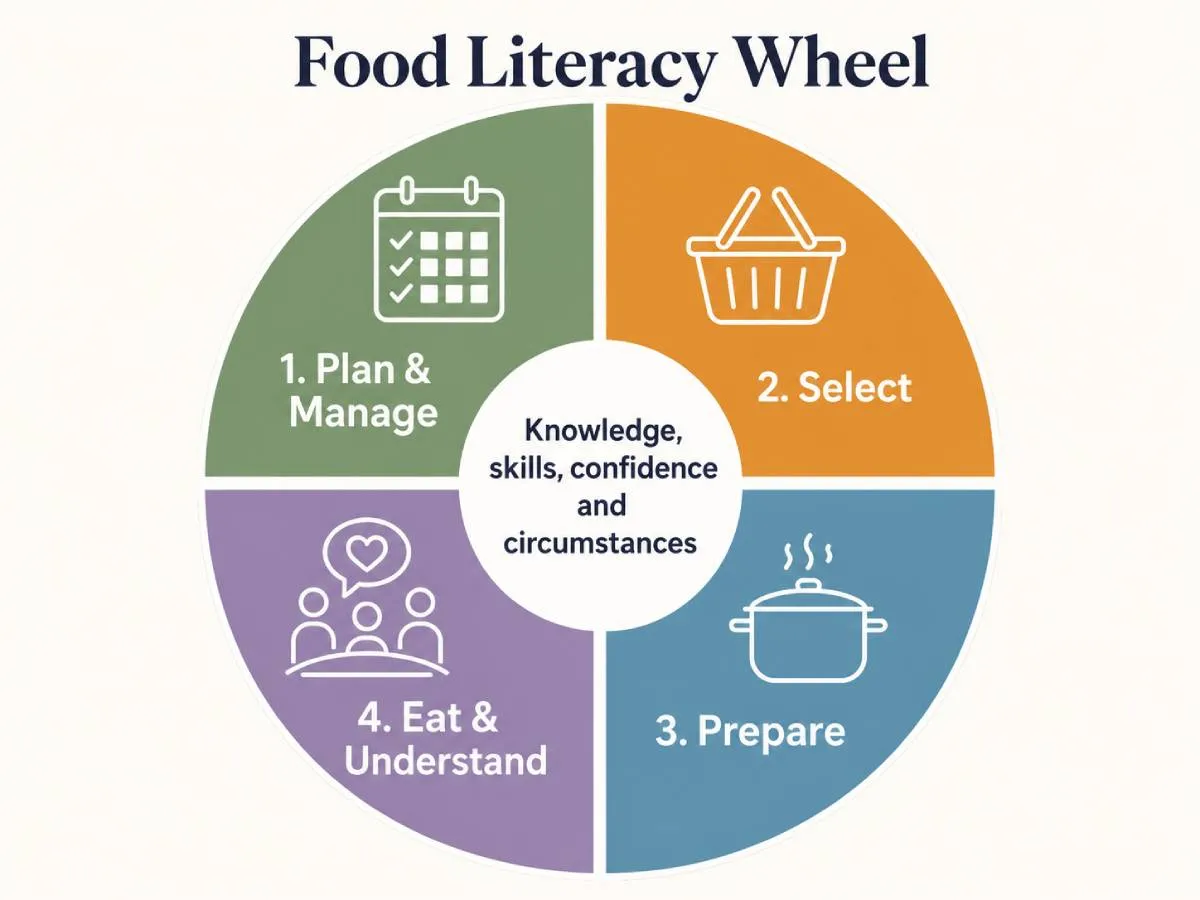
Food literacy brings together knowledge, action and judgement. Vidgen and Gallegos’ widely used framework identifies four connected domains: planning and management, selection, preparation and eating. A later scoping review of food-literacy attributes organised 15 attributes into five broader categories: food and nutrition knowledge, food skills, self-efficacy and confidence, food decisions, and ecological influences.
Several related terms overlap with food literacy, but they are not identical.
Nutrition literacy is mainly concerned with finding, understanding, evaluating and using nutrition information. It may include understanding nutrients, serving information, dietary guidance and health claims.
Cooking skills are the hands-on and organisational abilities used to prepare food. Knife work, boiling, roasting, seasoning, timing several dishes and using equipment safely are cooking skills.
Food knowledge is what someone knows about ingredients and food. It can include varieties, seasonality, flavour, origins, processing, quality and how ingredients behave during cooking.
Food-safety knowledge covers practices that reduce food-related risk, such as avoiding cross-contamination, cooking and cooling food appropriately, and storing perishable food safely.
Food literacy connects these areas and adds the ability to use them in daily life. It includes deciding what is realistic, obtaining food, adapting plans, navigating information and making choices within a household’s circumstances.
Reviews comparing the concepts have found that food literacy is generally broader than nutrition literacy. Nutrition literacy often centres on accessing and interpreting nutrition information, while food literacy also includes practical action, food choices and critical reflection on the effects of those choices.
A person may know that vegetables contribute useful nutrients but still be unsure how to choose them, store them, cook them or use what remains. Equally, a confident home cook may prepare varied meals without being able to interpret every nutrition claim on a package.
Food literacy recognises that everyday eating depends on several capabilities working together.
The four practical areas of food literacy
The four areas below are connected rather than sequential. Selecting food affects what can be prepared. Planning affects what gets purchased. Cooking experience affects which plans feel realistic. Eating preferences influence all three.
Planning and managing
Planning and managing means turning needs, resources and intentions into a workable food routine.
This can involve:
- looking at the coming day or week before choosing meals;
- estimating how much time and energy will be available;
- managing a grocery budget;
- checking the fridge, freezer and cupboards before shopping;
- choosing meals that use overlapping ingredients;
- remembering food that needs to be used soon;
- planning suitable portions and leftovers;
- changing the plan when work, travel, illness or family needs intervene.
Good planning does not require a perfect seven-day schedule. It may be as simple as knowing which two evenings are too busy for cooking and keeping an easy meal available for them.
The skill lies in making food decisions that fit real life rather than an idealised routine.
Planning is also where waste can often be prevented. Knowing that half a bunch of herbs, an opened carton or cooked grains are already available can influence the next meal before those ingredients are forgotten.
Selecting food
Selecting food means choosing ingredients and products that suit the purpose, budget, preferences and circumstances.
This can include:
- comparing two similar products;
- reading ingredient lists and relevant label information;
- deciding between fresh, frozen, dried, canned or prepared options;
- recognising reasonable quality and freshness;
- choosing the right variety of an ingredient for a recipe;
- considering cost per usable amount, not only the displayed price;
- accounting for allergies, dietary needs and cultural preferences;
- adapting to what is available locally.
Selection is not always about finding a single “best” food. A frozen vegetable may be more practical than a fresh one when storage is limited or the next shopping trip is several days away. A familiar staple may be more useful than an unfamiliar ingredient that is likely to go unused.
Food literacy supports comparison without pretending that all households face the same options. Availability, transport, shop location, price and time can narrow the choices before personal preference enters the decision.
Preparing food
Preparing food includes more than performing a technique correctly. It also involves interpreting instructions, sequencing tasks and responding when the kitchen does not match the recipe.
Examples include:
- reading a recipe from beginning to end before starting;
- identifying preparation that must happen in advance;
- understanding the order and timing of steps;
- using knives, heat and appliances safely;
- applying techniques such as simmering, roasting, steaming or sautéing;
- judging doneness using more than a stated time;
- making a reasonable substitution;
- scaling a recipe;
- coordinating a main dish and accompaniments;
- tasting and adjusting seasoning;
- cooling and storing leftovers appropriately.
Recipes often assume background knowledge. “Cook until softened”, “reduce the sauce” or “fold gently” are short instructions that rely on the reader knowing what to look for.
Food literacy helps turn those words into action.
It also supports recovery. If a sauce is too thick, an ingredient is unavailable or dinner must be delayed, a food-literate response is not necessarily perfect. It is a safe and workable adjustment.
Eating and understanding food
Eating and understanding food concerns how people experience food, interpret information and connect eating with social and cultural life.
This can include:
- recognising hunger, appetite, satisfaction and personal preferences;
- understanding that food choices are shaped by culture, family and identity;
- appreciating variety without treating unfamiliar foods as morally superior;
- sharing food and participating in meal traditions;
- noticing how different foods work for different occasions;
- evaluating food and nutrition claims critically;
- understanding that food reaches the table through wider systems of production, processing, distribution and labour.
Research definitions of food literacy commonly include not only knowledge and skills but also culture, emotions, food choices and food systems.
This area prevents food literacy from being reduced to domestic efficiency. Food is not only fuel or a list of tasks. It can carry memory, belonging, care, pleasure, routine and social meaning.
Critical understanding also matters because food information can be incomplete, commercial or contradictory. Food literacy does not require expertise in every scientific debate. It means being able to ask useful questions:
Who is making this claim? What evidence is offered? Is the advice relevant to my situation? Is a complex issue being presented as a simple rule?
What food literacy looks like during an ordinary week
Imagine a household preparing for the week ahead.
They first check the calendar and notice that cooking will be realistic on four evenings. One evening will end late, another includes a family commitment, and the weekend remains flexible.
They choose four dinners. Before writing a shopping list, they check the kitchen and find rice, lentils, two carrots and a packet of frozen peas. They choose recipes that use several of the same ingredients, reducing the number of one-purpose items they need to buy.
At the shop, they compare two suitable products, select produce that will last until it is needed and change one ingredient because the planned variety is unavailable.
At home, they refrigerate perishables, freeze one item intended for later in the week and place the ingredients that need using first where they will be seen.
Midweek, the evening schedule changes. Instead of abandoning the plan or forcing a time-consuming recipe into a short window, they move one meal to the next day and prepare a quicker option using ingredients already available.
The final act of cooking is only one part of this sequence. Checking the schedule, choosing a realistic number of meals, using what is at home, selecting food, storing it and adapting to change are all expressions of food literacy.
Food literacy is affected by circumstances
Food literacy is not exercised in a vacuum. A person’s ability to plan, select, prepare and eat food is shaped by the environment around them.
Important influences include:
- Time: Long commutes, shift work and unpaid care can reduce the time available for shopping and cooking.
- Income: A person may understand what they would like to buy but be unable to afford it consistently.
- Food access: Nearby shops may offer limited ranges, unsuitable package sizes or few culturally relevant foods.
- Kitchen space: A small or shared kitchen changes what can be stored and prepared.
- Equipment: Advice that assumes an oven, freezer, blender or reliable refrigeration may not be usable.
- Physical ability: Pain, fatigue, dexterity, mobility, vision and other factors affect kitchen tasks.
- Family responsibilities: Feeding children, older relatives or people with different needs adds coordination.
- Cultural knowledge: Familiar techniques, ingredients and meal patterns can support capability, while unfamiliar systems can create barriers.
- Confidence and experience: Repeated practice makes decisions easier; a history of criticism or failed attempts can make the same tasks feel risky.
The concept of food agency developed by Trubek and colleagues is helpful here. It presents meal preparation as an interaction between technical abilities, cognitive capacities and the social, cultural, physical and economic conditions in which food decisions are made. Cooking therefore involves more than knowing the correct mechanical steps.
Food agency has also been examined in survey research. In two United States samples, researchers found associations between food agency, cooking behaviour and dietary intake. Because the study was observational, these associations do not prove that greater food agency directly caused the reported behaviours or dietary differences.
In other words, knowing how to cook does not guarantee that a person has the time, facilities, support or control needed to produce a meal.
This distinction matters because advice can become unfair when it treats every food difficulty as a knowledge deficit. Skills can help people navigate constraints, but they do not erase those constraints.
A simple food-literacy self-check
Use these questions as prompts for reflection, not as a test or health assessment. You do not need to answer “yes” to all of them.
- Can I identify three possible meals using food already at home?
- Can I look at my schedule and decide which days are realistic for cooking?
- Can I create one grocery list from several planned meals?
- Can I recognise which ingredients should be used first?
- Can I compare two similar packaged products using information relevant to me?
- Can I choose between fresh, frozen, canned or dried forms of an ingredient?
- Can I understand the order and timing of a recipe before I begin?
- Can I safely use the main equipment required for meals I regularly prepare?
- Can I tell when a familiar food is cooked, rather than relying only on the clock?
- Can I make a reasonable substitution when one ingredient is unavailable?
- Can I store common leftovers appropriately and decide when to use or freeze them?
- Can I question a food claim and look for a more reliable source before acting on it?
The useful question is not “What is my score?” It is “Which one of these abilities would make my week easier if I improved it?”
This checklist is deliberately a reflection tool rather than a validated measurement instrument. Researchers have developed several food-literacy questionnaires, but a review of adult food-literacy measures found variation in their validity, reliability and alignment with the broader concept of food literacy. Development of an international food-literacy survey has included a dedicated content-validity study examining whether proposed items adequately represent the different components of food literacy.
How to improve food literacy gradually
Food literacy grows through repeated, manageable practice. Trying to transform every part of eating at once usually creates more work than confidence.
Plan one day ahead
Look at tomorrow and decide only what one main meal will be. Check whether the required food is already available and whether any preparation needs to begin earlier.
Once this becomes easy, extend the habit to two or three days.
Learn one versatile cooking technique
Choose a technique that works across many ingredients, such as roasting vegetables, simmering a basic soup, cooking grains or making a pan sauce.
Repeat it with small variations until the method, not just one recipe, becomes familiar.
Understand one ingredient category
Learn how to select, store and use one group you buy often: leafy vegetables, lentils, eggs, rice, yoghurt, tinned beans or frozen vegetables.
Practical knowledge about ten familiar ingredients is often more useful than shallow knowledge about fifty.
Organise frequently used recipes
Keep a small collection of recipes you have actually cooked and would repeat. Add notes about substitutions, timings and household preferences.
A useful recipe library is a decision tool, not an archive of everything that looked appealing.
Review what was wasted
At the end of the week, notice what was thrown away or forgotten without blame.
Was too much purchased? Was an ingredient hidden? Did the plan assume more cooking time than the week allowed?
Use the answer to make one adjustment.
Improvement is most durable when it reduces friction. The goal is not to perform food expertise. It is to make the next ordinary decision easier.
What food literacy cannot solve by itself
Food literacy can strengthen capability, confidence and adaptability, but it cannot solve structural problems on its own.
It cannot make unaffordable food affordable. It cannot create extra hours for someone experiencing time poverty. It cannot add suitable shops to an area with limited food access, provide a safe kitchen where facilities are inadequate, remove disability or mobility barriers, or make an unpredictable work schedule stable.
It may help someone stretch ingredients, make substitutions or organise food more effectively. Those benefits are real.
But presenting food literacy as the answer to food insecurity or unequal access places responsibility on individuals for conditions they did not create.
Food-agency research similarly treats food procurement and preparation as something that occurs within social, physical and economic environments rather than as an outcome of cooking skill alone.
A trustworthy approach holds two ideas at once: practical knowledge and skills can improve everyday control, and social and material conditions strongly determine how far those skills can be used.
Putting food knowledge into practice
Keeping useful recipes, weekly plans and shopping information organised can make everyday food decisions easier. Kitchgrow is designed to support that process.
Sources
- Defining food literacy and its components
Foundational qualitative study that developed the four food-literacy domains: planning and management, selection, preparation and eating. It provides a conceptual framework rather than a scored measurement tool.
- Identifying attributes of food literacy: a scoping review
Scoping review identifying 15 food-literacy attributes across five categories. It maps how the concept has been described in research rather than testing a single universal definition or assessment tool.
- Measuring Food Literacy: Progressing the Development of an International Food Literacy Survey Using a Content Validity Study
Examines the content validity of items proposed for an international food-literacy survey. Content validity is one stage of instrument development and does not by itself establish every form of reliability or validity.
- A Scoping Review of the Validity, Reliability and Conceptual Alignment of Food Literacy Measures for Adults
Reviews adult food-literacy measurement tools, their psychometric properties and their alignment with the four-domain framework. It evaluates existing instruments rather than measuring food literacy in a new population.
- Empowered to cook: The crucial role of ‘food agency’ in making meals
Develops the food-agency concept, explaining how technical abilities interact with cognitive, social, cultural and material circumstances. It provides a conceptual and qualitative foundation rather than causal evidence.
- Food Agency in the United States: Associations with Cooking Behavior and Dietary Intake
Based on two United States survey samples of adults and parents. It reports associations between food agency, cooking behaviour and dietary intake; the observational findings do not establish causation.