Meal Planning vs Meal Prep vs Menu Planning: What Is the Difference?
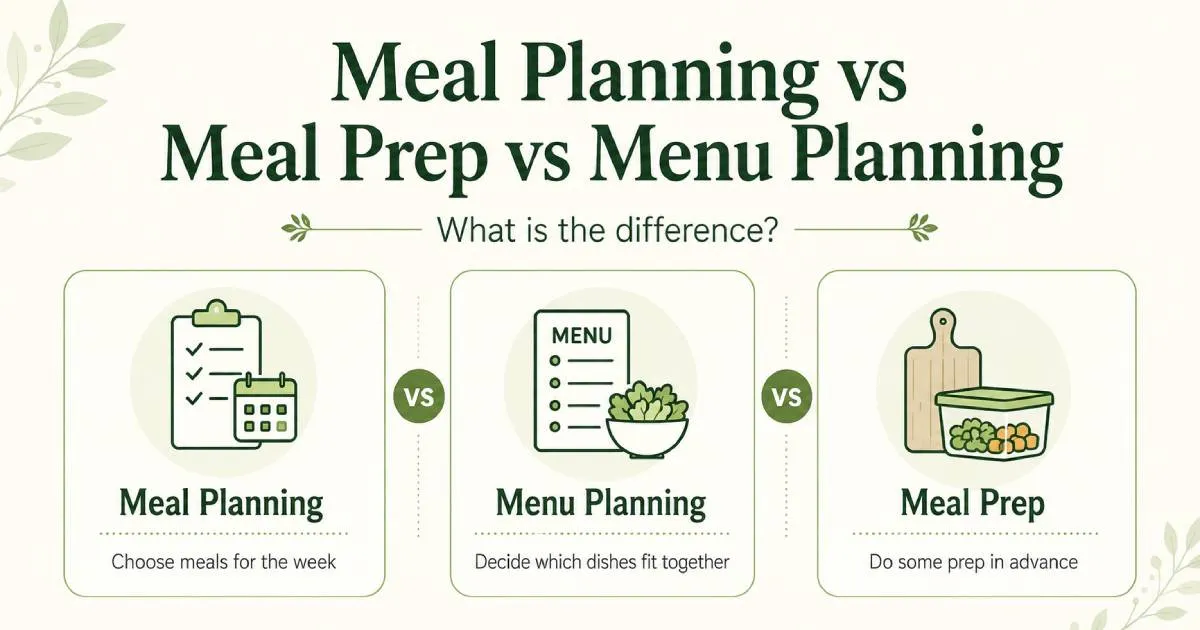
Meal planning decides what meals you will eat and when. Menu planning chooses dishes that work well together for a meal, household, event or food service. Meal prep completes ingredients or cooking tasks in advance. The terms overlap, so these are practical working definitions rather than universal rules.
Key takeaways
- Meal planning decides what you will eat and when you expect to eat it.
- Menu planning considers how dishes, courses, flavours and textures work together.
- Meal prep completes ingredients, components or entire meals before they are needed.
- You can plan meals without cooking anything in advance, and you can prepare useful components without following a rigid weekly plan.
- The most practical system is usually a flexible combination: plan a few important meals, identify shared ingredients and prepare only the tasks that will genuinely save time.
The difference between meal planning, menu planning and meal prep is mainly the kind of decision being made.
Meal planning is a decision about meals. Menu planning is a decision about how dishes fit together. Meal prep is the physical work completed before cooking or eating.
A person might use all three in the same week, but they do not have to. You can choose Tuesday’s dinner without preparing it on Sunday. You can also cook a pot of rice in advance without deciding exactly which meals it will become.
Understanding the distinction helps because each activity solves a different kitchen problem. Meal planning reduces uncertainty. Menu planning improves the combination of foods. Meal prep moves useful work away from your busiest times.
Meal planning, menu planning and meal prep compared
| Activity | Main question | Typical output | Example |
|---|---|---|---|
| Meal planning | What will we eat, and when? | A weekly or daily meal schedule | Pasta on Monday and lentils on Tuesday |
| Menu planning | Which dishes work well together? | A designed meal, menu or sequence of dishes | A main dish with a contrasting side and a simple dessert |
| Meal prep | What can be completed in advance? | Prepared ingredients, components or complete meals | Chopped vegetables, cooked rice or portioned lunches |
The three activities can form one continuous workflow, but they can also be used independently. The right combination depends on your schedule, household, storage space and preferred way of cooking.
What is meal planning?
Meal planning means deciding in advance what meals you expect to eat over a particular period.
That period might be one day, several weekdays or a full week. A meal plan does not need to cover every breakfast, lunch, dinner and snack. It can be as simple as choosing three important dinners before shopping.
A practical meal-planning process usually includes:
- choosing the meals you intend to cook or assemble;
- matching those meals to the time available on different days;
- considering the preferences and needs of the people eating;
- checking the refrigerator, freezer and cupboards;
- identifying ingredients that can be used across several meals;
- creating or updating a shopping list.
This working definition is consistent with University of Minnesota Extension’s description of meal planning as deciding ahead which meals a household will eat. Its guidance also recommends checking food already at home and reviewing planned recipes before making a shopping list.
A meal plan is therefore more than a list of appealing recipes. It connects food choices to the realities of the week.
For example:
- Monday is busy, so dinner is an omelette with toast and salad.
- Tuesday allows more time, so dinner is lentil curry with rice.
- Wednesday may involve eating out.
- Thursday uses leftover lentils in wraps or bowls.
- Friday remains flexible.
That is a valid meal plan even though it does not schedule every meal or require a large weekend cooking session.
Meal planning is also one part of broader food literacy skills: selecting food, managing available resources, preparing meals and adapting decisions to real circumstances.
What does research say about meal planning?
Meal planning has been associated with greater food variety and better overall diet quality, but that association does not prove that planning itself caused those outcomes.
A cross-sectional study of 40,554 adults in France found that participants who reported planning meals were more likely to have higher food-variety scores and greater adherence to nutritional guidelines. The researchers explicitly cautioned that the observational design could not establish causality.
People who already have more interest in cooking, nutrition or household organisation may also be more likely to plan. Meal planning should therefore be presented as a practical organisational tool—not as a guaranteed health intervention.
What is menu planning?
Menu planning focuses on selecting dishes that make sense together.
At home, it may mean deciding that a rich main dish needs a fresh, crisp side rather than another heavy dish. For an event, it may mean arranging appetisers, mains and desserts in a suitable sequence. In a restaurant or institution, it can become a much larger operational process.
Menu planning may be used for:
- a single household dinner;
- several days of family meals;
- a dinner party or celebration;
- a restaurant’s selection of dishes;
- a school, hospital or workplace food service;
- a recurring menu that changes on a daily or weekly cycle.
The central question is not simply, “What are we eating?” It is, “Do these foods belong together for this occasion and this group of people?”
Useful considerations include:
- whether the flavours complement or compete with one another;
- whether the plate has a mixture of soft, crisp, light and substantial textures;
- whether several dishes require the same last-minute cooking method;
- whether the meal suits the occasion;
- whether the menu provides enough choice for the people being served;
- whether the available equipment, time and budget can support it.
Professional menu-planning guidance for institutional food services may also consider staffing, kitchen equipment, serving arrangements, product availability, cost, food safety and nutrition requirements.
At home, the process can be much simpler.
Suppose you have already chosen vegetable lasagne for Saturday. Meal planning has placed the lasagne on Saturday. Menu planning helps you decide what belongs around it: perhaps a sharp green salad and fruit afterwards, rather than garlic bread, roast potatoes and a heavy pudding.
What is meal prep?
Meal prep means completing food preparation before the moment when the food will be cooked, assembled or eaten.
It does not always mean filling identical containers with complete meals. Meal prep can happen at three different levels.
Ingredient preparation
Ingredient preparation completes small jobs while keeping the final recipe undecided.
Examples include:
- washing salad leaves;
- chopping onions or carrots;
- peeling garlic;
- measuring spices;
- marinating an ingredient;
- portioning fruit or snacks.
This form offers flexibility because the ingredients can still be used in several different dishes.
Component preparation
Component preparation produces a useful building block rather than a complete meal.
Examples include:
- cooking a pot of beans;
- roasting a tray of vegetables;
- making a tomato sauce;
- cooking rice or another grain;
- preparing a dressing;
- mixing a spice paste.
A prepared component can often be combined differently across the week. Roasted vegetables might become a grain bowl, a pasta addition or a side dish.
Complete meal preparation
Complete meal preparation produces a dish or portion that needs little more than reheating, finishing or serving.
Examples include:
- portioned lunches for several working days;
- a complete casserole stored for later;
- breakfast jars assembled in advance;
- soup divided into individual portions;
- freezer meals prepared for a particularly busy period.
This approach saves the most work later, but it also requires more storage space and more confidence about when the meals will be eaten.
For example, current UK Food Standards Agency guidance on leftovers advises cooling cooked food and refrigerating it within two hours, using refrigerated leftovers within 48 hours or freezing them, and reheating leftovers only once until steaming hot throughout.
Can you meal plan without meal prepping?
Yes. Meal planning does not require advance cooking.
You might select five dinners for the week, buy the required ingredients and cook every dish fresh on the day it is scheduled.
For example:
- Monday: vegetable stir-fry;
- Tuesday: chickpea curry;
- Wednesday: pasta with tomato sauce;
- Thursday: baked fish or tofu with vegetables;
- Friday: homemade pizza.
Nothing has to be chopped, cooked or portioned on Sunday. The plan is still useful because it removes the daily decision about what to make and ensures that the necessary ingredients are available.
This approach suits people who enjoy freshly cooked food, have limited refrigerator space or do not want to spend part of the weekend preparing weekday meals.
Can you meal prep without following a strict meal plan?
Yes. You can prepare versatile ingredients without assigning them to fixed meals.
For example, you might:
- cook rice;
- roast peppers, courgettes and onions;
- prepare a yoghurt or tahini sauce;
- wash salad leaves;
- cook a batch of lentils.
During the week, those components could become a grain bowl, wrap filling, salad, soup or side dish.
This is sometimes more practical than complete meal preparation for people with unpredictable schedules. The preparation reduces weekday work, but the final meal can still change according to appetite, time or who is eating.
The limitation is that completely unplanned preparation can create waste. Before cooking a large quantity, make sure the ingredient is versatile enough to use and that you have a realistic window in which to eat or freeze it.
How do meal planning, menu planning and meal prep work together?
The three activities work best when planning comes before preparation.
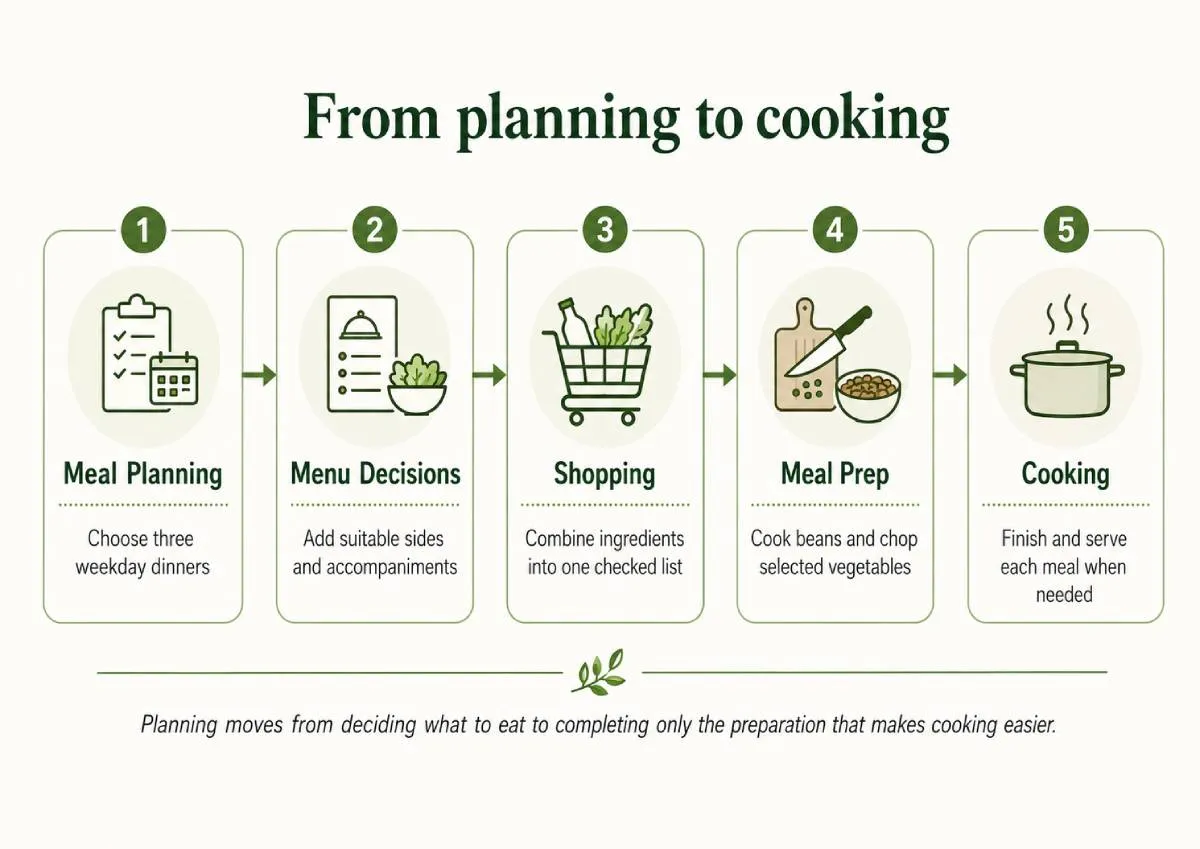
A practical four-step workflow is:
- Choose the meals.
Start with the days that most need a decision. Consider the calendar before browsing recipes. - Decide how the dishes fit together.
Add sides, accompaniments or simple desserts only where they improve the meal. Avoid creating unnecessary work for the sake of making the plan look complete. - Identify shared ingredients.
Look for useful overlap. Spinach might work in an omelette, curry and pasta. A sauce might serve two meals. Shared ingredients are helpful when the dishes remain distinct enough to be enjoyable. - Prepare only the tasks worth doing early.
Advance a job when it will save meaningful time, improve convenience or prevent an ingredient from being forgotten. Leave jobs until later when early preparation would reduce quality or create unnecessary storage.
Shopping sits between the decisions and the physical preparation. Once the meals and useful overlaps are clear, the shopping list can be based on what is actually needed rather than on a collection of unrelated recipes.
Meal planning becomes easier when recipes, weekly plans and shopping ingredients stay connected. Kitchgrow is one way to organise that workflow digitally.
Which approach is right for you?
Choose the activity that solves your biggest problem rather than trying to adopt a complete system at once.
| Your situation | Prioritise | Practical approach |
|---|---|---|
| Your schedule changes frequently | Flexible meal planning and component prep | Choose a few possible meals and prepare ingredients that can move between them |
| Weekday cooking time is limited | Meal planning and targeted meal prep | Schedule the busiest days first and complete one or two time-consuming tasks early |
| You cook for one | Loose meal planning | Plan fewer meals, use ingredients across dishes and freeze suitable extra portions |
| Household preferences differ | Meal planning and menu planning | Agree on flexible main dishes with optional toppings, sides or components |
| Your refrigerator is small | Meal planning with minimal prep | Buy realistic quantities and avoid storing several complete cooked meals |
| You prefer freshly cooked food | Meal planning | Make decisions and shop ahead, but leave most cooking until the day |
| You are hosting an event | Menu planning | Check how the dishes, courses, timings and cooking methods work together |
A household may also need a different approach from one week to the next. A busy work period may justify complete meal prep, while a quieter week may need only a list of dinners.
What common mistakes make planning harder?
Planning every meal too rigidly
A plan that leaves no space for delays, leftovers, changing appetites or social invitations is easy to abandon.
Plan the meals that matter most and keep at least one flexible period.
Preparing more food than you can realistically use
Large batches are not automatically efficient. They can create repetitive meals, crowded storage and avoidable waste.
Before doubling a recipe, decide when the extra portions will be eaten or frozen.
Ignoring storage capacity
A meal-prep plan must fit the refrigerator and freezer you actually have. Containers also need enough room to cool and store food safely.
Check available space before shopping or cooking.
Choosing unrelated recipes with long ingredient lists
Five individually appealing recipes can make a poor weekly plan if each requires a separate collection of specialist ingredients.
Look for sensible overlap, but do not force every meal to taste the same.
Treating meal prep as an all-or-nothing weekend task
You do not need to spend several hours preparing an entire week.
Ten minutes spent washing vegetables, mixing a sauce or cooking one useful component can still reduce friction later.
What is a simple beginner system?
Begin with three planned meals and one or two prepared components.
- Choose three anchor meals.
Select the meals that will be most useful to decide in advance. For many households, these are three weekday dinners. - Leave one evening flexible.
Use it for leftovers, a spontaneous meal, eating out or a change of schedule. - Keep one low-effort backup.
Choose something that can be assembled from reliable cupboard, refrigerator or freezer ingredients. - Prepare one or two shared components.
Cook rice, make a sauce, wash salad leaves or chop one frequently used vegetable. Do not prepare everything simply because it can be prepared. - Check the plan halfway through the week.
Review what has been eaten, what remains and which ingredients need using first. Move meals rather than abandoning the whole plan.
A beginner week might include a lentil curry, pasta with vegetables and a tray-baked meal as the three anchors. One evening remains flexible, while eggs, frozen vegetables or soup provide the backup. The only advance preparation might be cooking lentils and making one sauce.
That is enough to create structure without turning food into a tightly controlled project.
Frequently asked questions
Is meal planning the same as meal prep?
No. Meal planning decides what you expect to eat, while meal prep completes some of the physical work in advance. You can use either activity without the other.
Is menu planning only for restaurants?
No. Restaurants and institutions use formal menu-planning processes, but households also plan menus whenever they decide which dishes, sides or courses work together.
How many days should a beginner meal plan cover?
Start with the part of the week that creates the most difficulty. For many people, planning three dinners is more useful and sustainable than trying to schedule every meal for seven days.
Do I need a special day for meal prep?
No. Preparation can be spread across the week. You might cook an extra component while making dinner, wash vegetables after shopping or prepare tomorrow’s lunch while clearing the kitchen.
The practical difference
Meal planning, menu planning and meal prep are related, but they are not interchangeable.
Meal planning chooses the meals. Menu planning improves the combination. Meal prep completes useful work early.
You do not need to perform all three extensively. Begin with the problem you want to solve: uncertainty, poorly matched dishes or lack of time. Then use the smallest amount of planning or preparation that makes the week easier.
Sources
- What to eat when money is tight
Practical guidance page rather than a research study. Used to support the working definition of meal planning and the advice to check existing food, review planned recipes and prepare a shopping list. The page was reviewed in 2026.
- Meal planning is associated with food variety, diet quality and body weight status in a large sample of French adults
Cross-sectional observational study of 40,554 French adults. Meal planning, weight and height were self-reported. The results show associations with food variety and diet quality but cannot establish that meal planning caused those outcomes.
- Menu Planning
Guidance written for school nutrition and food-service operations, not specifically for household meal planning. Used only to support professional considerations such as preferences, kitchen equipment, serving location, food costs and labour.
- Cooking your food
Official food-safety guidance applying to England, Northern Ireland and Wales. Used for advice on refrigerating leftovers within two hours, eating or freezing them within 48 hours, reheating until steaming hot throughout and reheating only once. Readers elsewhere should also follow guidance from their local food-safety authority.